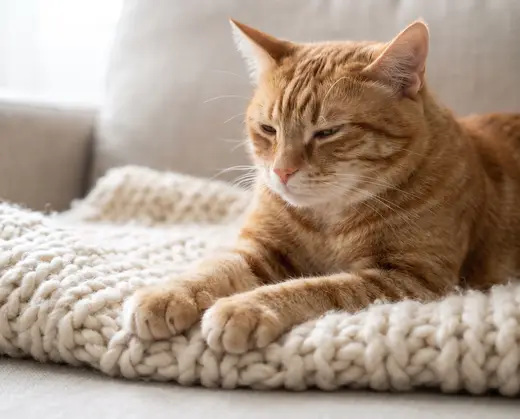
How do cats purr?
A purr is made in the voice box, or larynx. Muscles there twitch very fast, opening and closing the space between the vocal cords. As air passes through on both the in-breath and the out-breath, it creates that steady, rumbling vibration. That's why a cat can purr continuously, for minutes at a time, without stopping for breath.
Purring is usually quoted at roughly 25–150 Hz, a low, deep range. Exactly how the brain controls it is still not fully understood.
5 reasons cats purr
1. They're content. This is the classic purr: a cat curled on your lap, eyes half-closed, body loose. It often comes with slow blinks and kneading, and it's one of the clearest signs your cat feels safe.
2. They're bonding with kittens. Kittens can purr from a few days old, while nursing. Mother cats purr too. Kittens are born unable to see or hear, so the vibration may help them find their mother and stay close. Many experts think this is where purring started: as a quiet signal between mother and kittens that all is well.
3. They want something. Many cats purr when they want food or attention. Some use a special version for this, covered below.
4. They're stressed or hurt. Cats also purr at the vet, after an injury, when they're very ill and while giving birth. In these moments purring seems to work as self-soothing, a way to calm themselves down, and possibly a signal that they're not a threat.
5. They're greeting you. Some cats purr as they come to meet you, rub against your legs or roll over. It's a friendly "hello".
The "feed me" purr
If your cat's breakfast purr sounds more urgent than its lap purr, you're not imagining it. A 2009 study led by Karen McComb at the University of Sussex looked at what researchers called the solicitation purr. Some cats mix a higher-pitched sound, a bit like a cry, into their usual purr when they want food.
When people listened to recordings, they rated these purrs as more urgent and less pleasant than normal purrs, even people who didn't own cats. The researchers suggested the sound may tap into the same instinct that makes us respond to a crying baby. It's a clever trick, and it works on a lot of us.
Happy purr or unwell purr?
Purring alone doesn't tell you how a cat feels. Look at the whole cat.
| What you see | What it likely means |
|---|---|
| Loose body, slow blinks, kneading, relaxed tail | Content and relaxed |
| Purring while rubbing, meowing, following you to the kitchen | Asking for food or attention |
| Purring at the vet, ears back, body tense | Stressed and self-soothing |
| Purring while hiding, hunched, not eating | Possibly in pain or unwell |
| Purring with fast or open-mouth breathing | Needs a vet urgently |
Can purring help cats heal?
You'll often read that purring helps cats heal their bones and muscles. The idea comes from the fact that purring falls in a frequency range that has been studied in vibration therapy for bone and tissue in people and other animals.
It's an appealing theory, and it might be part of why cats purr when hurt. But the evidence is limited. Nobody has shown that a cat's own purr speeds up healing. Treat it as an interesting idea, not a fact, and never as a reason to wait before seeing a vet.
Cats are very good at hiding pain and illness. A cat can purr while it's quite unwell, so a purr should never stop you from calling your vet if something else seems wrong.
When to see a vet
Purring on its own is never a reason to worry. Call your vet if your cat is purring and also:
- Hiding more than usual, or not coming out for food
- Not eating for more than a day, or eating much less
- Breathing differently: faster, with effort, or with the mouth open
- Sitting hunched with its eyes half-shut, or seeming tense when touched
- Having litter tray changes, such as straining, crying or going outside the tray
- Grooming one spot over and over, or not grooming at all
Cats rarely pant. If your cat is breathing with its mouth open, breathing fast at rest, or struggling to breathe, contact your vet or an emergency clinic straight away, purring or not.
What if my cat doesn't purr?
Some cats purr rarely, or so softly you can only feel it. That's usually just their personality. A quiet cat can be just as happy as a loud one. What matters more is a change: if a cat that always purred suddenly stops, or starts purring in unusual situations along with other changes in behaviour, it's worth mentioning to your vet.
Can I make my cat purr more?
You can't force a purr, but you can build the conditions for one. Give your cat a warm, quiet spot of its own. Let your cat choose when to come for a cuddle, and stroke where most cats like it: the cheeks, chin and the top of the head. Keep a predictable routine for meals and play. And respect the signals when your cat has had enough.
If your cat uses the "feed me" purr at 5 a.m., a puzzle feeder or timed feeder can help shift the focus from you to the bowl.
FAQ
Do all cats purr?
Most domestic cats purr, but some purr so quietly you can only feel it with a hand on their chest or throat. A cat that rarely purrs isn't necessarily unhappy.
Why does my cat purr so loudly?
Volume varies a lot from cat to cat. A loud purr is usually just your cat's natural style, not a sign of anything wrong.
Can a cat purr when it's dying?
Yes. Some cats purr when they're very ill, in labour or near the end of life, which is one reason vets don't treat purring as proof a cat feels well.
Does purring really heal bones?
It's an interesting idea, but it hasn't been proven. Purring falls in a frequency range that has been studied for healing, but there's no solid evidence that a cat's own purr heals its body.
Why does my cat purr and then bite me?
Some cats get overstimulated during long petting sessions. Watch for a twitching tail or flattened ears, and stop before it tips over.
This article is general information, not a replacement for advice from your vet.